Free Novel Analysis Worksheets That Work With Any Book
10 printable student activity pages to help students analyze plot, characters, conflict, and setting in any novel or memoir. Use them for literature circles, reading groups, independent reading, or a book report that goes beyond summary.
Benefits:
- One set for different books. No need to create separate analysis assignments for every reading group.
- Go beyond plot summaries. Students trace the story arc, support character observations with quotes and page numbers, and examine six types of conflict.
- Made for grades 6–12. Student-facing directions help students work through the activities with less guidance from you.
You’ll get the PDF plus occasional emails from Created for Learning. Unsubscribe anytime. Privacy Policy
What’s Inside the Free Novel Analysis Worksheets
These activities work with different novels, and the directions are written for students. That makes them easier to introduce, whether students are working independently or in groups.
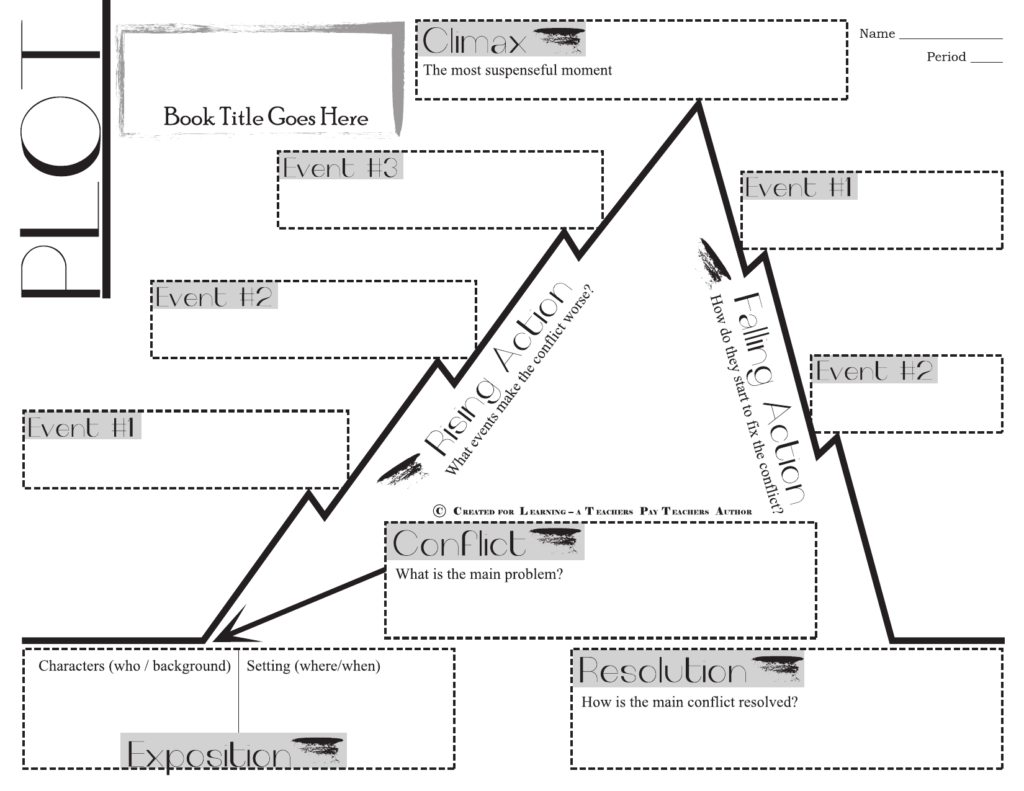
Students map the whole story arc: the exposition (characters and setting), the main conflict, three rising-action events, the climax, two falling-action events, and the resolution. Questions printed along the arc, like “What events make the conflict worse?”, keep them thinking about cause and effect instead of just retelling.
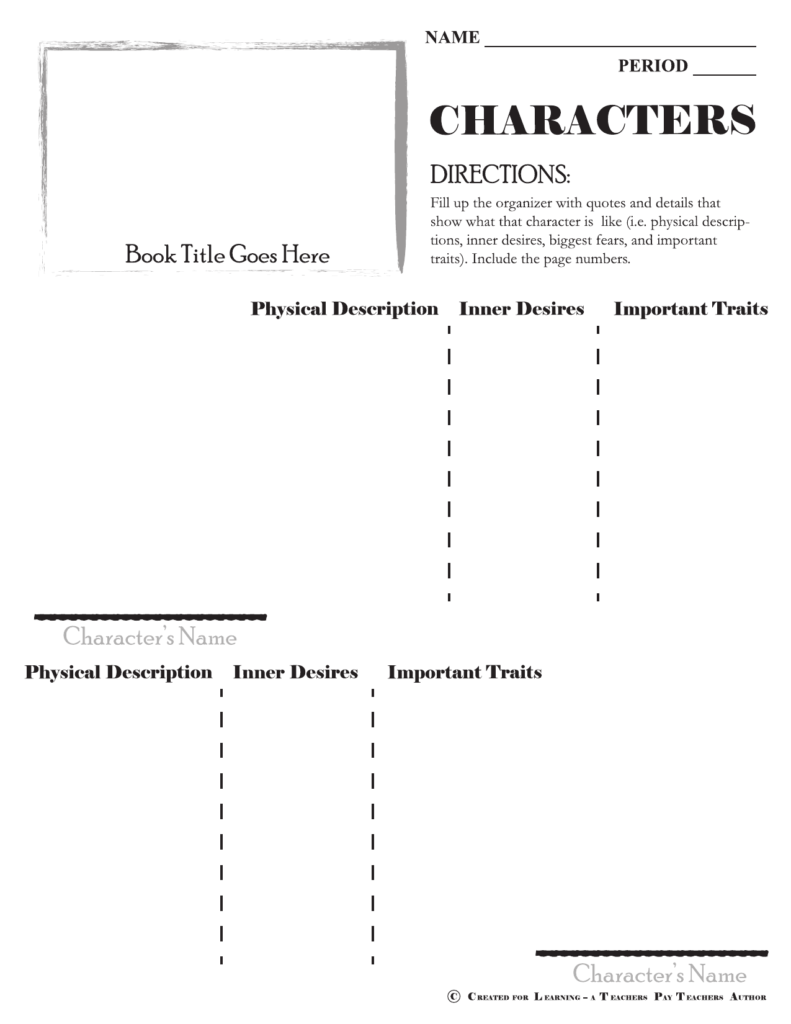
For each character, students fill in three columns: physical description, inner desires, and important traits. The directions ask for quotes and details with page numbers, helping students support their observations with evidence from the book. There’s room for up to 14 characters, so print as many pages as the book needs.
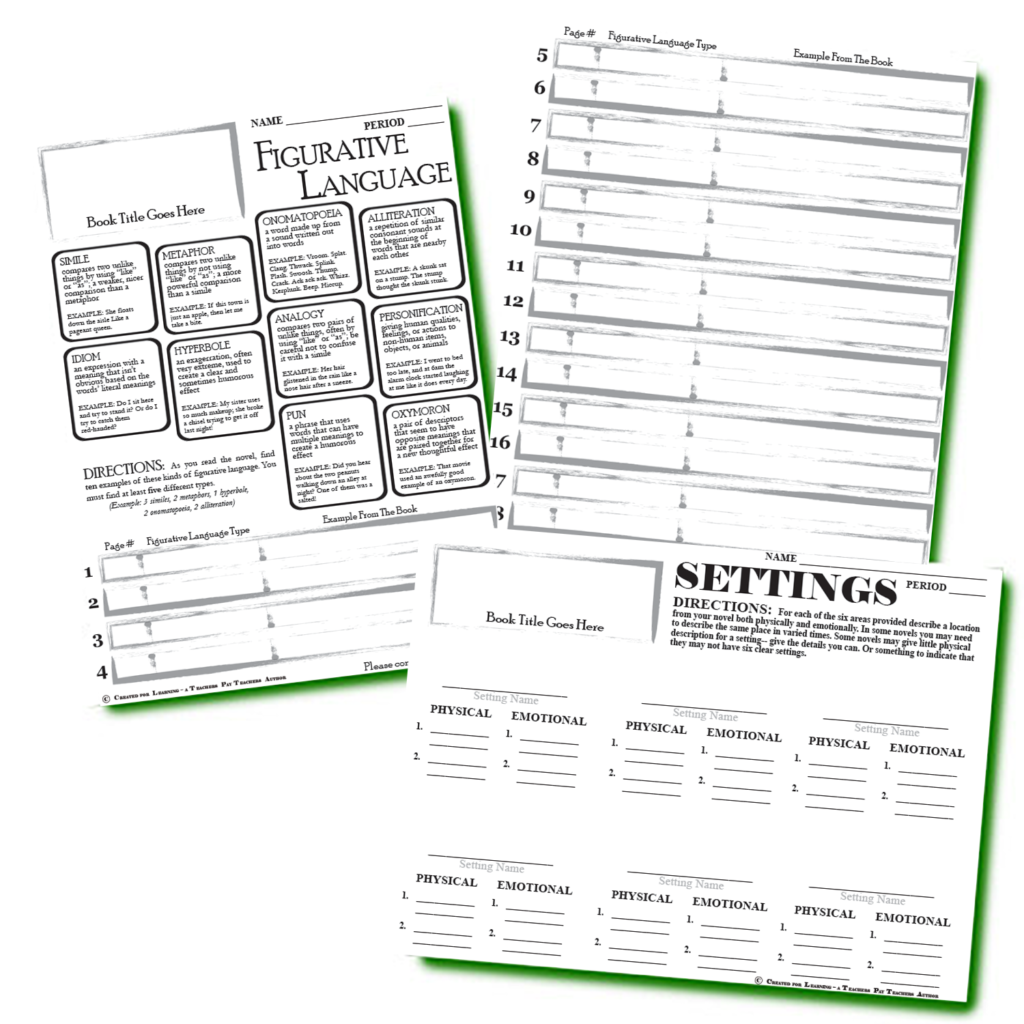
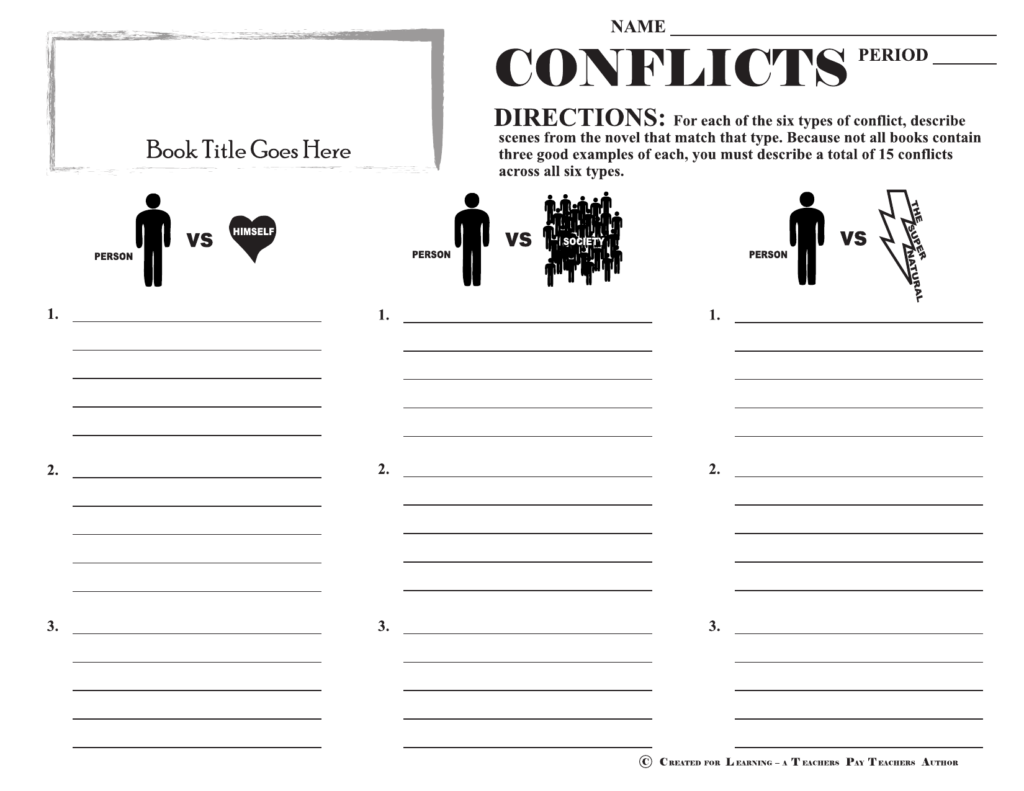
Students find scenes for six types of conflict: person vs. self, person vs. person, person vs. society, person vs. nature, person vs. technology, and person vs. the supernatural. They describe 15 conflicts in all. Since not every book has three good examples of each type, students have to decide where the real tension in their book is.
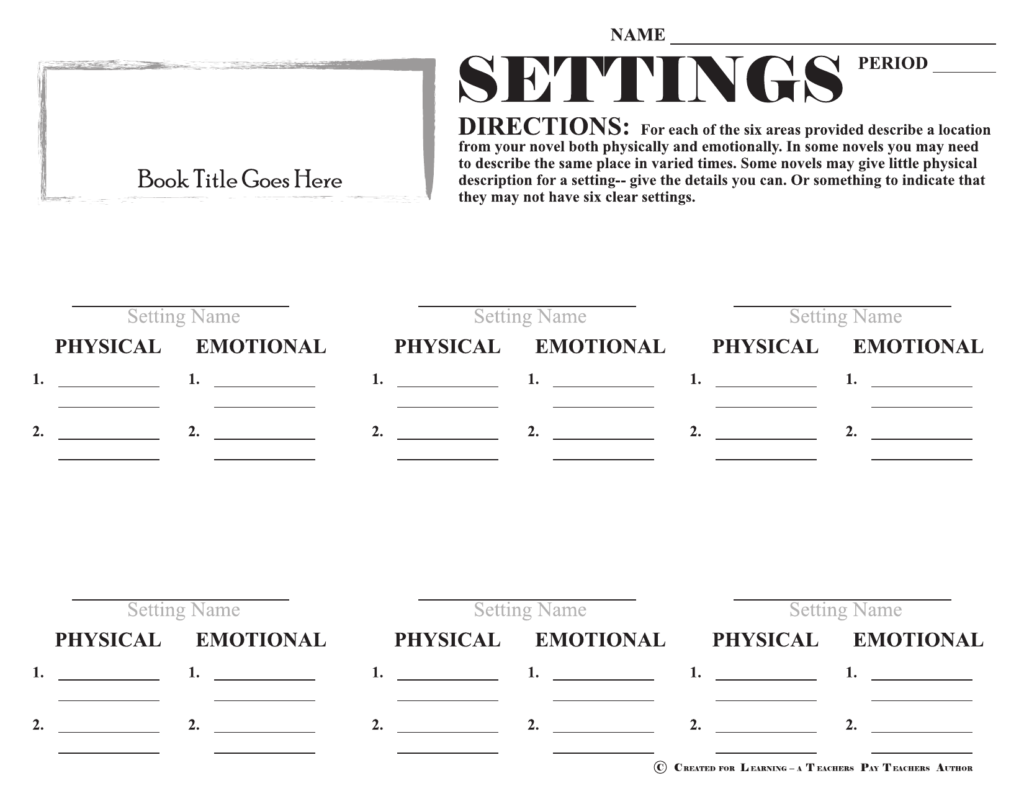
Students describe up to six locations both physically and emotionally. That means noticing how a place feels as well as how it looks, and sometimes how the same place changes over the course of the story.
To finish, students draw their own cover with images of the book’s important ideas, events, meanings, and characters. No clip art and no images from the internet: they draw it all, so the cover shows what they think matters most.
One Set of Worksheets for Every Book in the Room
Picture a class split into four or five literature circles, each reading a different novel. Every group needs something rigorous to work on. But planning five separate analysis activities for five different books? Most teachers don’t have that kind of time.
That’s the situation these worksheets were made for. The questions are about how stories work, not about one particular book, so they fit whatever your students are reading.
Literature circles
Each group can use the same worksheets with a different novel. You can also bring the groups together afterward to compare the characters and conflicts they found.
Reading groups
Work with one reading group while others use the worksheets. Student-facing directions mean you don’t have to explain a completely different assignment at every table.
Independent and student-choice reading
Students can choose their own books while you keep the analysis assignment consistent across the class.
Individual book reports
A book report that asks students to analyze plot, characters, conflict, and setting, not just summarize what happened.
Homeschool literature
Want to assign a novel that doesn’t come with a study guide? These pages give your student a clear structure for any book you choose.
Take a Look Before You Download
Here are a few of the pages your students will work with. Each one prints in black and white on standard letter-size paper.
Meet Jonathan

Hi, I’m Jonathan. I’ve taught English for 13 years, from 6th grade all the way up to college seniors, though most of that time was spent in 7th- and 8th-grade classrooms. Created for Learning grew out of that work.
I’m not that interested in teaching students what to think. I care much more about how they think, and about convincing them that they should. These worksheets are built on that idea: students go back to the book, find the evidence, and work it out for themselves.
Outside the classroom, I’m a dad, an actor (I call it full-body storytelling), and a writer of young adult novels.
Ready for Whatever Your Students Are Reading Next?
Get one set of printable worksheets your students can use to analyze plot, characters, conflict, and setting across different books.
Frequently Asked Questions
Yes. None of the questions are tied to a specific book, so they work with any novel, and with memoirs too. Some books won’t have three examples of every conflict type or six clear settings. The directions tell students that’s okay and to work with what the book gives them.
They’re designed for grades 6–12. With younger middle schoolers, it helps to model a page together before they work on their own.
Yes, and that’s the main reason they exist. Every student or group gets the same pages, whatever book they’re reading.
A printable PDF sent to your email. It has 10 student pages in black and white on US letter-size paper, a mix of portrait and landscape pages. The PDF isn’t editable.
No. It’s a blank analysis framework, so there are no lesson plans, answer keys, or book-specific questions. If you’re teaching a particular novel and want the analysis already worked out for you, take a look at our complete novel study units on Teachers Pay Teachers.