TL;DR
The best figurative language stories are short, packed with similes, metaphors, and personification, and simple enough for students to read in one class period. Ray Bradbury, Sandra Cisneros, and James Hurst top the list because their stories tie language to everyday life, family, and identity in ways that hold student attention. Pair any short story on this list with a slideshow that teaches the elements of figurative language up front, and you have a full lesson your kids will actually finish.
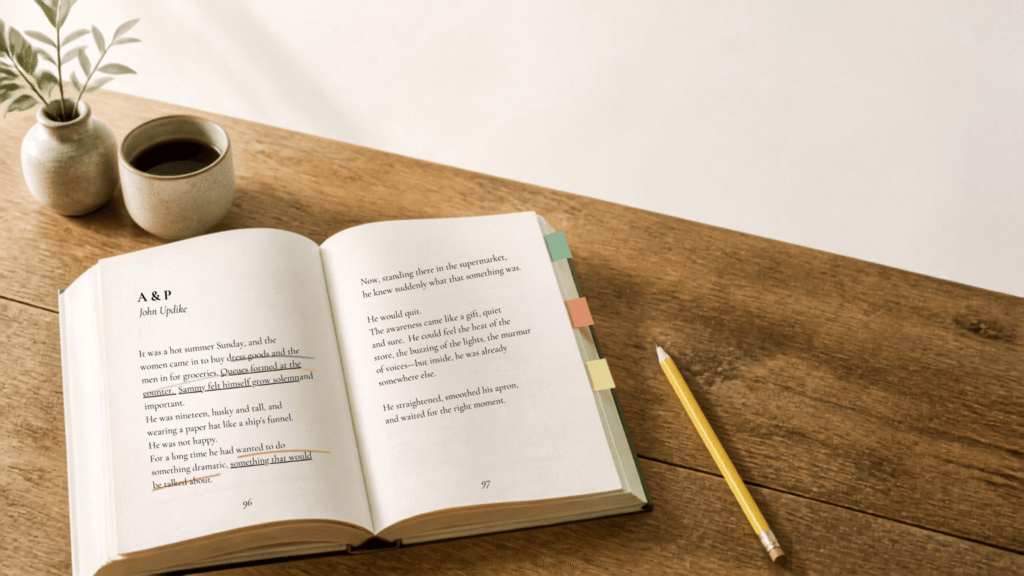
The list below covers 10 short stories that teach figurative language well across grades 5 and up. You will get devices to teach, writer levels that fit, and one teaching move per story. Short stories also make a strong lead-in to a bigger novel unit, which is one reason they work so well as a hook at the start of a new book.
Key Takeaways
- Short stories give students a full text they can read in one sitting, which makes figurative language easier to understand and track.
- The best stories layer multiple elements, so you can teach similes, metaphors, and personification from a single text.
- Match the story to the writer level (Honors/AP, standard, low-performing, language learners), not just the grade level.
- Pair each story with a clear model, a student practice task, and a short writing follow-up.
- A slideshow with named devices and clear examples cuts your prep time and gives students a reference they can use all year.
10 Short Stories That Work for Teaching Figurative Language
Each short story below invites readers into a moment where the language does the work. Every pick includes devices to teach, writer levels that fit, and one teaching move.
| # | Story | Author | Best Devices | Writer Level Fit |
|---|---|---|---|---|
| 01 | All Summer in a Day | Ray Bradbury | Imagery, similes, personification | Standard, language learners |
| 02 | The Fog Horn | Ray Bradbury | Personification, extended metaphor | Standard, honors |
| 03 | There Will Come Soft Rains | Ray Bradbury | Personification, imagery, symbolism | Honors, AP |
| 04 | The Scarlet Ibis | James Hurst | Symbolism, similes, foreshadowing | Honors, AP |
| 05 | Eleven | Sandra Cisneros | Metaphors, voice, imagery | All levels, language learners |
| 06 | The Landlady | Roald Dahl | Personification, foreshadowing | Middle school standard |
| 07 | Marigolds | Eugenia Collier | Imagery, metaphors, symbolism | High school standard, honors |
| 08 | Charles | Shirley Jackson | Irony, characterization, tone | Middle school |
| 09 | Thank You, Ma’am | Langston Hughes | Dialogue, imagery, tone | Standard, language learners |
| 10 | The Gift of the Magi | O. Henry | Irony, similes, hyperbole | Standard, upper elementary stretch |
1. “All Summer in a Day” by Ray Bradbury
A class of kids on Venus waits for the sun to arrive for the first time in seven years. Margot remembers the sun. The other kids do not. What happens next is a quiet, painful tale about memory and cruelty.
Devices to teach: imagery, similes, personification, metaphors
Best fit: standard students, language learners, 5th grade and above
One teaching move: Have students underline every line that describes the rain, the clouds, or the sun. Bradbury describes rain as a storm and the sun with soft, hopeful light. The contrast between the two is the whole lesson.
Get the plot arc activity here.
2. “The Fog Horn” by Ray Bradbury
A lighthouse keeper and his partner discover that a fog horn is calling something ancient out of the deep. It is a strange, beautiful tale about loneliness. The setting does a lot of the emotional work.
Devices to teach: personification, extended metaphor, imagery
Best fit: standard, honors
One teaching move: Ask students what the fog horn “means” beyond the sound it makes. This is a great way to introduce extended metaphor without using the phrase first.
3. “There Will Come Soft Rains” by Ray Bradbury
A house continues its daily process after the family who lived there is gone. The house is the main character. The title comes from a poem, and the poem drops into the middle of the story.
Devices to teach: personification, imagery, symbolism
Best fit: honors, AP
One teaching move: List every action the house performs. Then ask students what kind of person the house is being. If your students take to Bradbury after this one, his novel is a natural next step, and there is a full Fahrenheit 451 unit here if you want to keep the momentum moving.
4. “The Scarlet Ibis” by James Hurst
A brother tells the tale of his younger brother, Doodle, and the guilt he carries. The ibis in the title is the key to the whole story. This one hits hard, and students remember it.
Devices to teach: symbolism, similes, foreshadowing, imagery
Best fit: honors, AP
One teaching move: Have students track color words through the text. Red, scarlet, and blood tie together in ways students can find and defend with lines from the story.
5. “Eleven” by Sandra Cisneros
Rachel turns eleven and has to wear a red sweater that is not hers. The metaphor of age as rings inside a tree gives kids something clear to hold onto. The voice is simple, the feeling is not.
Devices to teach: metaphors, voice, imagery
Best fit: every level, especially strong for language learners
One teaching move: Read the opening paragraph out loud. Ask students to write their own version using the same “you are still” pattern. This is the fastest way to move students from spotting a metaphor to writing one.
6. “The Landlady” by Roald Dahl
Billy Weaver checks into a bed and breakfast run by a very kind, very strange older woman. Students will not forget the ending. Dahl builds tension through details students can go back and find.
Devices to teach: personification, foreshadowing, imagery
Best fit: middle school standard
One teaching move: After reading, have students mark every clue Dahl planted in the first half. This teaches close reading without calling it that.
7. “Marigolds” by Eugenia Collier
Lizabeth looks back on the summer she destroyed her neighbors’ marigolds. The story is about hope, poverty, and the moment a child becomes something else. The imagery is rich and worth slowing down for.
Devices to teach: imagery, metaphors, symbolism
Best fit: high school standard, honors
One teaching move: Ask students what the marigolds mean to Miss Lottie and what they mean to Lizabeth. The gap between those two answers is the theme.
8. “Charles” by Shirley Jackson
A mother hears about a boy named Charles from her kindergarten-age son every day after school. Charles is the reason kindergarten is chaos. The twist lands because Jackson keeps the language simple.
Devices to teach: irony, characterization, tone
Best fit: middle school
One teaching move: Do not tell students the twist. Let them find it. Then talk about how the author uses simple words to hide a big reveal.
9. “Thank You, Ma’am” by Langston Hughes
A child tries to steal a purse from Mrs. Luella Bates Washington Jones. What she does next surprises him more than her. The story is short, the meaning is great, and students love the ending.
Devices to teach: dialogue, imagery, tone
Best fit: standard, language learners
One teaching move: Have students act out the opening in pairs. Hughes writes dialogue that carries much of the meaning, so hearing it makes the surrounding imagery easier to feel.
10. “The Gift of the Magi” by O. Henry
A young couple with almost no money each sell their most valued possession to buy the other a Christmas gift. The irony hits hard. The tale is short enough to read out loud in one class period.
Devices to teach: irony, similes, hyperbole
Best fit: standard, upper elementary stretch
One teaching move: Before reading the last two pages, pause and ask students to predict. The prediction is what makes the ending land.
How to Pick a Short Story That Teaches Figurative Language
If your favorite tale is not on the list above, here is how to know a short story will do the work you need.
Look for Figurative Language on the First Page
If a student has to read three pages before hitting a strong simile, you will lose them before the lesson starts. Open the story and skim the first 500 words. If you can mark two or three elements, you have a good candidate. Bradbury opens almost every story this way, which is why he shows up on this list three times.
Pick Stories Where the Language Does the Heavy Lifting
Some short stories rely on plot. Others rely on the author’s description of a moment. For teaching figurative language, you want the second kind. Bradbury, Cisneros, and Hurst all fit this. Their stories move more slowly on plot and spend more time describing the world, the wind, the light, and the feet of a child moving through a room.
Separate Reading Level From Teaching Level
A story can be simple to read but rich to understand. “Eleven” is a good example. The words are simple. The metaphor is not. Match the reading level to your students. Match the teaching level to what you want them to notice.
Ready-to-Use Discussion Questions and Writing Prompts
These work across most of the stories above. Use them as a warm-up, an exit ticket, or a full discussion.
Discussion Questions
- What is one line where the author described something in a way you had not seen before?
- What feeling did that description create? Fear, hope, love, sadness? How did the writer build it?
- Find one simile and one metaphor. Which one felt stronger? Why?
- If the writer had described this moment plainly, what would readers lose?
- Where does the author use personification? What is the effect of giving something human traits?
- If you had to cut one line from the story to save on a poster, which line would you save?
Writing Prompts for Practice
- Rewrite one paragraph from the story using no figurative language at all. Compare the two versions.
- Write a short poem or paragraph describing a moment from your everyday life. Use at least one simile, one metaphor, and one line of personification.
- Pick a setting from the story and describe it as if it were a character. Give it feelings, actions, and a mood.
- Write the same moment two ways: one from a child’s head, one from a mother’s. What changes?
If you want a lower-lift writing option, the quickwrite prompt format works well for short stories, too. Students write for a set number of minutes without stopping, and you get real evidence of their thinking without a stack of essays to grade.
Save the Prep With a Slideshow Students Can Follow
The slowest part of teaching figurative language is not the reading. It is writing out the definitions, finding clean examples, and building a reference students can refer to all year.
That is what the Figurative Language Instructional Slideshow and Activity is for. It walks students through each device, providing clear definitions and practice examples.
What Is Inside
- Named definitions for similes, metaphors, personification, hyperbole, and more
- Clean example lines students can refer to during any reading
- A student-facing activity that connects the lesson to practice
How to Use It
- Teach as a stand-alone intro before your first short story
- Leave it up as a reference while students annotate the text
- Hide any slides that are too complicated for your needs today. Or include them as an exploration of all the ways authors play with creative language.
- Use it as a review before a unit test or writing assignment
It drops into digital notebooks with minimal setup and works for grades 5 and up.
One Last Thing Before You Teach This
Pick one story from the list. Just one. Print it or pull it up. Open the figurative language slideshow and let it teach you the definitions. Give students one focused task, not five. That is a full lesson.
The stories are already written. The prep is already done. Your job tomorrow is to walk into class, hand out a great short story, and let students see what strong writing looks like. When you want that student writing to reflect what they learned, this approach to grading writing faster will save you the second half of your week.
Frequently Asked Questions
What grade level are these short stories best for?
Most work from 5th grade through AP. “All Summer in a Day,” “Eleven,” and “Charles” fit upper elementary and middle school best. “The Scarlet Ibis,” “Marigolds,” and “There Will Come Soft Rains” fit high school and AP.
How many class periods should I plan for a figurative language unit?
One short story with discussion and a short writing task fits in one to two class periods. A full unit using three or four stories takes about two weeks. Start with a slideshow on the elements, then move into the stories, then a writing task.
Can I use these short stories with language learners or lower-performing readers?
Yes. “Eleven,” “All Summer in a Day,” and “Thank You, Ma’am” are the strongest picks. The English is accessible, the stories are short, and the figurative language is clear enough to spot. Read the tale out loud, then have students mark the elements with a partner.
What if my students confuse similes and metaphors?
Teach them side by side. Show a simile like “Her voice was like a bell” next to a metaphor like “Her voice was a bell.” Students see the difference at a glance, and the word “like” becomes the marker they remember.
Should I teach one device at a time or all together?
Teach the definitions together at the start so students have the full vocabulary. Then, when you read a short story, focus on one or two devices at a time. A single-device focus leads to better reading comprehension and student writing.